
Before the RFP: How HOA Boards Can Use Repair History To Build Smarter Capital Scopes
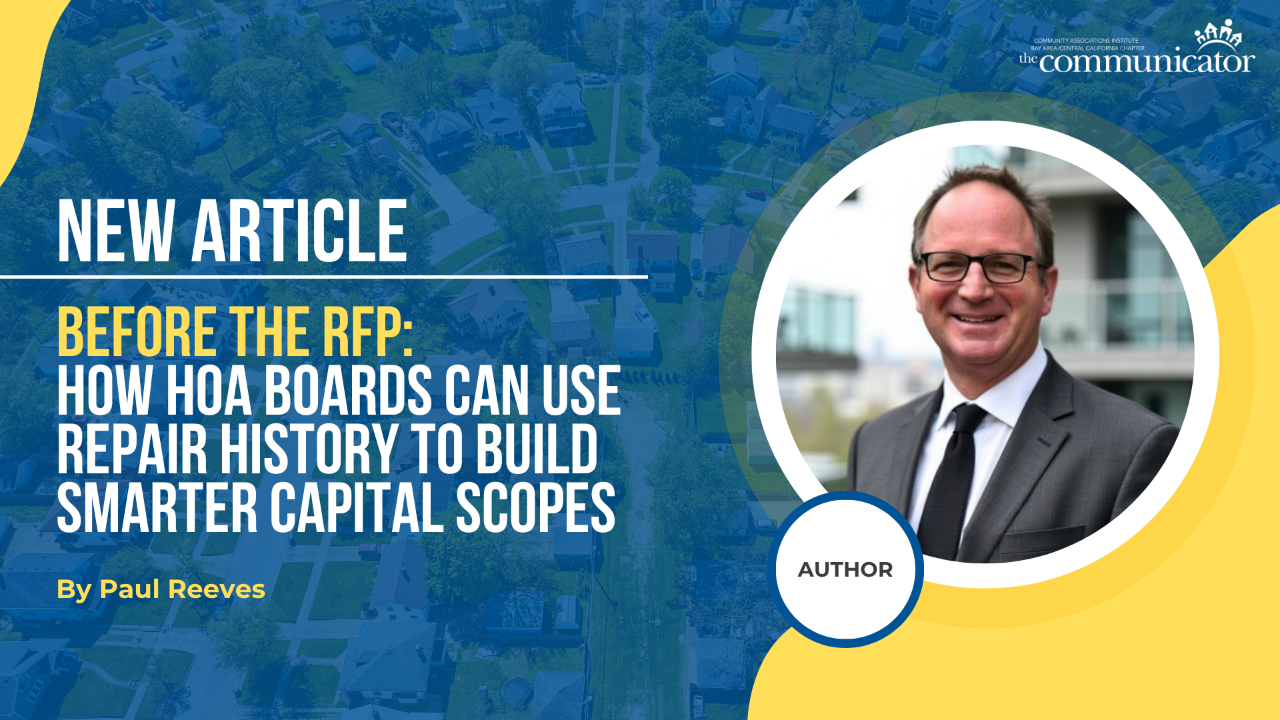
By Paul Reeves
This article first appeared in the Communicator Magazine, Summer 2026 Issue.
The Bid Is Not the Starting Line
Every week, I talk to boards and property managers who are in a hurry to get bids out. I get it. There’s real pressure. The owners are asking questions, the reserve study is flagging things and it feels like the clock is running. So, the natural instinct is: Let’s get it priced and move on.
The problem is that the RFP is downstream. By the time you send it out, the important decisions have already been made, whether you made them deliberately or not. If the scope isn’t right going in, you don’t get clean bids. You get guessing. Every contractor fills in the blanks differently, and then you’re trying to compare apples to oranges and wondering why the bids are $200,000 apart.
The real work happens earlier. It starts with understanding what your property has actually been through.
Pull Out the Reserve Study. Then Ask What It Actually Assumed.
Most boards treat the reserve study like a funding document. It is, but it’s also something else: It’s the original plan. It tells you which buildings were included, which components were expected to need work, when those repairs were supposed to happen and what the repair cycles were assumed to be.
When I come into a project, one of the first things I do is pull that component list and confirm the basics. You’d be surprised how often I find buildings that were accidentally left out, or components that were lumped so broadly they’re basically useless as a planning tool. And there’s always the question of responsibility boundaries, and these are not obvious at all. The wood door going into the side of a garage and its frame? Usually homeowner. The trim around the outside? Association. The big automobile-access garage door? Homeowner. The building frame around that door? Association. These distinctions matter when you’re scoping work and when a contractor shows up and starts asking questions you don’t have answers to.
What I wish more boards handed me when I show up for the first time: the reserve study and the history of what they’ve actually done, ideally going back 20 to 25 years. Not just what it cost. What the scope of work was at that time. That history is everything when you’re trying to figure out what comes next.
Now Put That Next to What Really Happened
Take the reserve plan and put it side by side with the actual repair history. Not just the spend, but what did you do, where did you do it and what happened after.
The data you need is rarely in one clean place. It lives in work orders, board packets, old contractor proposals, change order logs, photos. Sometimes the best source is a long-time board member who remembers the project that went sideways, or the office manager who had to chase down change orders for three months. Don’t discount those people. They know things the invoices don’t show.
What you’re looking for: what was completed on schedule, what got deferred, what got accelerated because something failed earlier than expected and what interim fixes got added between planned cycles. Things like the pest report repairs that come up every time a unit sells. Those patterns are not just maintenance stories. They’re telling you something about what your next scope needs to address.
One thing I see consistently when I compare reserve studies to real repair history: The reserve study will say “dry rot repair and paint” as one line item, and then in the actual history, you’re seeing roof dry rot billed separately, fencing separate from siding repair, common-area fencing separate from patio fencing. A private fence around a patio is very different from the common-area fence running down one end of the property, and they’re often equal in cost or the common area can actually be more. Reserve studies frequently don’t break that down, which means the next time you go to scope the work, you’re starting from a number that doesn’t reflect what you’re actually dealing with.
The Repeating Repair Is a Clue, Not Just a Cost
Every board I talk to can tell me what’s broken. “We have dry rot.” “The paint’s failing.” “That same building always has issues.” That’s not the hard part. The hard part is asking: Why does it keep coming back?
I worked on a large property where every 10 to 12 years, when they’d come through and do siding repair and paint, they were replacing window trim over and over. The siding under those windows wasn’t flashed correctly at the top. Water was getting behind the trim, rotting out the back of it and the siding underneath. At every unit, they were looking at $600 to $1,200 in change orders to fix this. Every single cycle.
The actual fix was $180 worth of upgraded flashing at each window. I was able to go to the board and explain what had been happening for the last 40 years and what the real fix would be. They approved it. Going forward, every time we hit a window with bad dry rot on the siding and trim, we upgraded the flashing. That problem is gone.
This is what I mean when I say the repeating repair is a clue. If your buildings are all similar design, look at whether the same repairs keep happening in the same spot on each building. That’s not bad luck. That’s a design condition that hasn’t been addressed. And if you just write another “replace dry rot as found” scope, you’ll be having this same conversation in another decade.
The Question Most Boards Don’t Stop To Ask
Before you write a scope or send out an RFP, ask this: Has the scope actually changed since last time? Not just the price. The scope itself. Has the condition of the buildings shifted? Are you repairing symptoms because that’s all you’ve ever priced, or is there an opportunity to actually fix the cause?
This isn’t about spending more money. It’s about stopping the cycle of spending money on the same problem. Sometimes a targeted improvement, like better flashing details, upgraded materials at the failure points or correcting a drainage condition, means the next cycle doesn’t look exactly like this one.
What a Vague Scope Actually Looks Like
I don’t think boards write bad scopes because they’re lazy. I think they’re well-meaning and they just don’t realize how much detail is actually required. A scope that says “repair the dry rot on this building and include every wall, make the project turnkey so it’s ready to paint” sounds reasonable. But it leaves every important question unanswered.
Are you splicing sheets of siding or replacing full sheets? Are you splicing trim boards or replacing complete trim boards? Does the replacement include priming? Does it include painting? These aren’t small details. Every contractor reading that scope is going to answer those questions differently, which means every bid you get back is pricing a different project.
A refined scope does a few specific things: It builds in what you learned from past repairs, it separates true capital work from recurring maintenance, it defines what’s in and what’s out, and it handles the unknowns with allowances or unit pricing instead of leaving them open-ended. Open-ended scopes become open-ended change orders. Every time.
Why Copy-Pasting Last Time’s Scope Is a Risk
Repeating the same scope feels safe. You’ve done it before, and you know roughly what it costs; it’s familiar. But in an aging community, the same scope applied to conditions that have evolved is how you end up spending more and getting less.
When the scope doesn’t match the actual conditions, the project runs on change orders. The written scope becomes almost irrelevant. The real scope gets negotiated in the field, usually in a hurry, usually without the board having the full picture. Owners notice. They’ve been watching their association spend money on the same building for years, and nothing seems to stay fixed. That erodes trust in the board fast.
The RFP Should Price Decisions You’ve Already Made
A well-run RFP is a control tool. It creates comparable bids, defines expectations and locks in accountability on both sides. But it only works when the scope going in is clear enough to actually price.
When contractors have to fill in the blanks themselves, you don’t get competitive bidding. You get parallel guessing. I had a situation recently where one contractor was calling me with questions and another contractor was calling the property manager with the same questions. They were getting two different answers. One bid came back exactly double the other. Once we got everyone answering from the same information, the bids came back much closer together. That wasn’t a contractor problem. That was a scope problem.
The RFP should be the point where the association says: Here’s what we’ve decided to do, here’s the standard we expect, here’s how bids will be compared. When you do the upstream work, that’s exactly what it becomes.
What Happens When You Miss It Before the RFP Goes Out
A few years back, I was brought in on a project at a large complex, 250 units. They had already sent the RFP out and were starting to get proposals back. The scope of work looked short to me. When I dug into it, I found out they had hired a third party to do the inspections, but that inspector hadn’t gotten access to all the patios. It was noted somewhere in the paperwork that certain patios had been missed, but nobody had communicated that clearly. Nobody flagged it.
Twenty to twenty-five percent of the walls on that property had never been inspected. On a project that was approaching a million dollars, we were already looking at $200,000 to $250,000 in change orders before the first nail was driven. We stopped, went back, got access to every patio, inspected everything, did an addendum to the RFP and put it back out to bid. It was the right call, but it cost significant time and created real headaches for the board that didn’t need to happen.
That’s what catching it late looks like. It’s recoverable, but just barely.
What Makes a Scope Defensible
HOA boards make decisions in public. There are owners in the room with opinions, sometimes loud ones. A defensible scope isn’t just technically correct. It’s explainable. When someone stands up and asks “Why are we doing it this way?” the board should be able to point to evidence: here’s what the reserve assumed, here’s what actually happened, here’s the pattern we identified, here’s why we changed the approach.
In my experience, when homeowners push back on a board decision, it usually gets tabled until more information can be gathered. The boards that handle that best are the ones that already did the homework. They can come back with answers. The boards that struggle are the ones whose only answer is “this is what the contractor recommended,” and that isn’t a great position to be in when you’re a fiduciary making decisions with other people’s money.
The Documentation That Protects the Next Board, Too
Most HOAs are better at doing projects than documenting them. And then three board members rotate off, the property manager changes and the next cycle starts from scratch with nobody who knows what was decided or why.
The fix doesn’t have to be complicated: keep a summary of what the reserve assumed, note what actually happened and what deviated from the plan, document the rationale for any scope changes. Attach it to the project file. Update it each cycle. That one document, even a few paragraphs, gives the next board somewhere to start that isn’t zero.
When Outside Help Makes the Most Difference
A lot of communities already have engineers, contractors and reserve professionals involved. What I do is different. I’m a construction consultant with 40 years as a general contractor, and I work as the liaison between the HOA board, the property manager and the contractors. I represent the association to the vendors, not the other way around.
Outside guidance adds the most value at a specific moment: when a board needs help translating what the repair history is actually telling them into a scope that reflects it, before the RFP goes out. That might mean stress-testing the scope assumptions, clarifying where capital work ends and recurring maintenance begins, identifying the repeating patterns the next scope needs to solve differently, or simply helping the board get to a clear decision before contractors start asking questions they aren’t prepared to answer.
The simplest thing any board can do right now before their next project: have an impartial third party look at the scope and the RFP with a critical eye. Someone whose only job is to help clarify things. That one step changes what you get back from contractors and what you’re able to defend to your owners.
The Boards That Get the Best Results
Strong projects don’t start with price. They start with learning from what the property has already been through.
The boards I’ve seen run the cleanest projects are the ones that did the upstream work: They pulled the reserve assumptions, compared them to what actually happened, identified the repairs that kept coming back and adjusted the scope before anyone bid. The bids came in tighter. The change orders dropped. The owners trusted the process more. And nobody was back in the same conversation years later wondering why the same building needed work again.
Your repair history isn’t just a record of what broke. It’s a roadmap. If you know how to read it before you write the scope, you end up with a better project and you stop paying for the same problem on repeat.
Paul Reeves is the founder of Reeves Construction Advisors, an independent advisory firm helping HOA boards in Northern California build defensible scopes, evaluate bids and make informed decisions before capital projects move forward. He serves as a trusted ally of HOA board members and property managers and does not bid construction work.