
EV Charging at Home: How EVEMS Make the Experience Better and Safer
By Caroline Selber and Breda Potter
This article first appeared in our Communicator Magazine, Winter 2026 Issue.
WHAT IS AN EVEMS AND WHY DO YOU NEED ONE?
For such a big acronym, electric vehicle energy management systems (EVEMS) are deceptively simple: They manage electricity.
But why you need one might not be so obvious. And finding out is important; to power an electric vehicle charger, your home will need enough electrical capacity.
All homes have an electric panel with breaker switches. Condos and apartments, also known as multi-unit residential buildings (MURBs) or multi-unit dwellings (MUDs), will have an electrical panel for each unit, and often only one more panel for lights and outlets in shared spaces, like a hallway. These panels commonly have a limit of 100 amps, sometimes 200 amps. This means that all of the electronics and appliances that you have running in your home must draw power less than the maximum number of amps your panel can afford, or else a breaker will trip, or an electrical connection will overheat.
A typical charger, which is a high-draw electronic, adds anywhere between 30 to 60 amps to your panel, which is a 30 to 60% increase in energy need. This is why most panels cannot afford to have electric vehicle charging equipment added directly to them.
And, while this might sound like a problem, it’s not. There is no need to upgrade your panel.
Energy management is a concept with a history of success; sometimes called load balancing, energy can be switched off and on so that not all appliances and devices operate at once to cause a shortage.
Most people turn to load management for any of these reasons:
- Adaptability: You want to manage several high-powered devices (EV charging stations, a hot tub, HVAC, or power tools) on a panel already at or near capacity.
- Cost Savings: You want to save money by avoiding major infrastructure or panel upgrades.
- Environmental Benefits: You want to save energy by optimizing the management potential of your existing infrastructure.
- Security: You want a safeguard and peace-of-mind when operating charging equipment.
- Efficiency: You would like to be energy efficient using what you already have.
Realizing the importance of these benefits to the home charging experience almost always takes place after an electrician or contractor inspects an electrical panel that is at or near capacity.
A panel upgrade is one solution but comes at a great cost, can involve long wait times, and can be a major renovation when all you’re trying to do is add an EVSE or charging equipment to your home panel.
SECURITY AND RELIABILITY: WIRED OR WIRELESS LOAD MANAGEMENT?
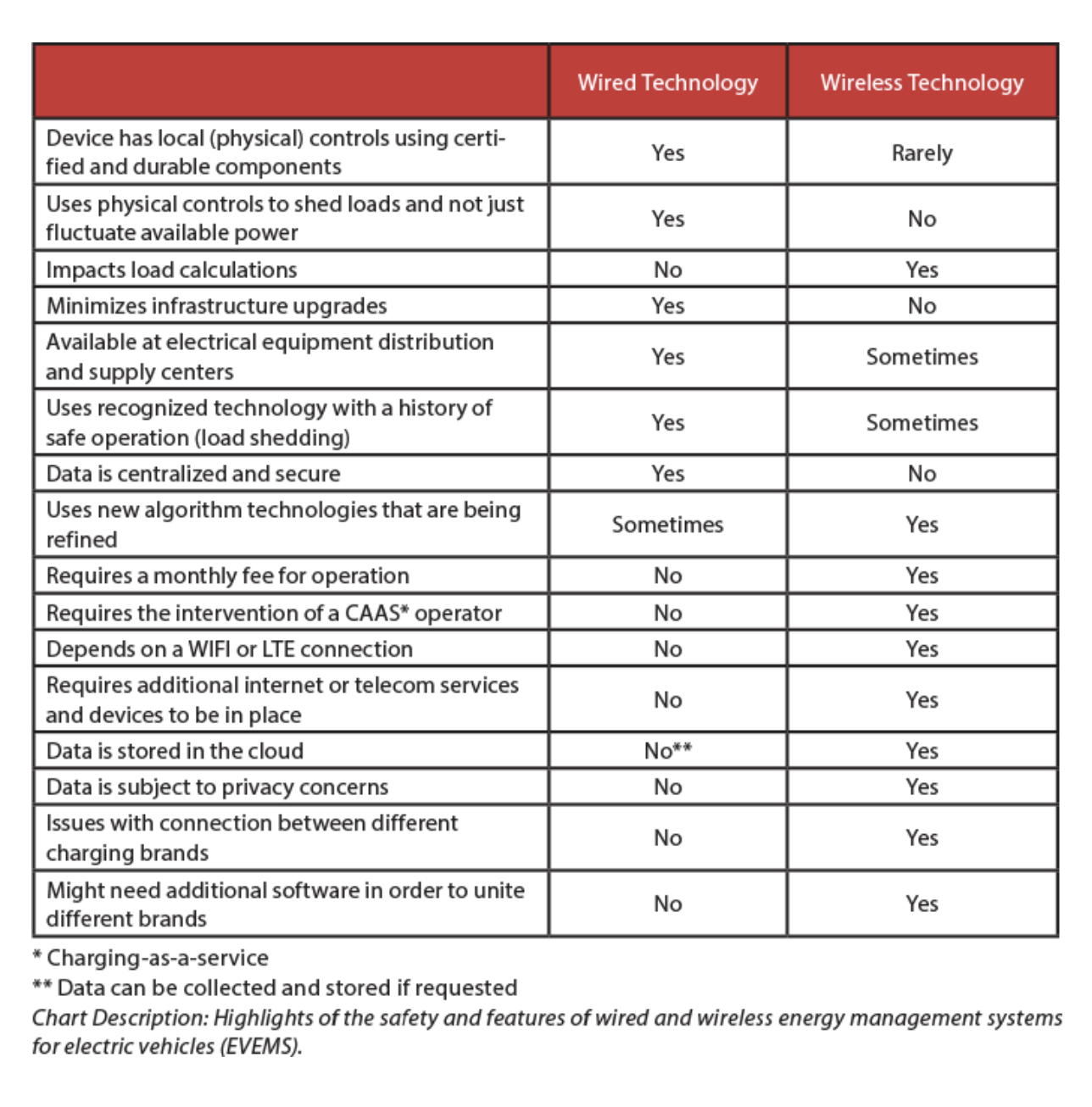
We recommend using load management products that are wired into the electrical infrastructure … But why? It’s true that electric vehicle supply equipment (EVSE) or EV charging stations have features that offer some kind of load or energy management, but does wireless software management work the same way as an Electric Vehicle Energy Management System (EVEMS)?
As electric vehicles (EVs) surge in popularity, our century-old electrical infrastructure faces a modern challenge: meeting the charging demands of our transportation. The numbers don’t lie: The average charging station requires significant power, and our current setups can only support a handful of them simultaneously. So, how do we navigate this transition?
UNDERSTANDING THE POWER OF EV CHARGING IN NUMBERS
Picture this: your home’s electrical panel hums along, serving its usual array of appliances and gadgets. Suddenly, you introduce an EV charging station into the mix, demanding a hefty 32 amps of consistent power. With most residential panels maxing out at 200 amps in a single-family home, and many panels in apartments and condos having even bigger limitations, you’re looking at a pretty serious roadblock to home charging access.
We know that on-the-street charging is not ideal, pay-per-use can be expensive, and lowering amperage can come at the cost of experience and charging speed. But charging at home can work – all it takes is adding an energy or load management system into the mix.
ENTER LOAD MANAGEMENT AND CONTROL FOR EV CHARGING
Load management really is the unsung hero of EV charging. Using panel monitoring and controlled load shedding, an energy management system for electric vehicles or EVEMS can power a charging station or EVSE without impacting panel capacity. This means no panel upgrades and a good charging experience for your private parking space (a full charge every morning!)
Some EV energy management systems (EVEMS) can also work by intelligently distributing electrical loads ensuring that multiple EVs can power up simultaneously without overloading the panel. This is indispensable for multi-family properties where multiple charging stations need to be powered reliably on limited capacity.
THE WIRELESS WORLD: A DIGITAL DILEMMA
While load management should be a key component in all electric vehicle charging station installations, there are different types of electric vehicle energy management systems to be aware of. The single greatest differentiating factor being that some depend on a wired configuration while others are installed to be wireless.
Today, many "Internet of Things" (IOT) devices depend on wireless connectivity to function (like smart thermostats, which can even do a bit of loose energy management). Many charging stations are built this way, too. They are called "networked" chargers.
But, the thing about energy or load management that depends on connectivity or a network, is that if connectivity fails, a server is down, a communication protocol between stations is interrupted (i.e. a Tesla charging station and a Chargepoint charging station do not use the same technology or management), or even if a charging station is damaged or malfunctioning, the most needed feature – the load management algorithm – ceases to operate.
There are too many unpredictable factors with wireless load management for it to be what the safety of charging stations and electrical infrastructure hinges on.
Imagine the lock on your front door. You can buy a lock with a digital component, or a "smart" lock, so that you can wirelessly connect to use it, or even add it to a smart home system. But when your WIFI fails, or you cannot connect to the app, you’ll want to be able to manually lock and unlock your door still.
When charging stations are not wired to do energy management, no manual energy or load management can take place; the feature you depend on just ceases to manage the energy. This is a capacity, security, and safety risk because when load management fails, infrastructure damage can take place.
THE WIRED ADVANTAGE: UNCOMPLICATED RELIABILITY AND SAFETY
This puts wired EVEMS or load management systems at a crucial advantage. While software-based energy management platforms uniquely offer data like scheduling and cost calculation, which can be good for shared charging, cloud-based systems are not equipped with the wired technology needed to control and monitor electrical loads. Importantly, they cannot shed electrical loads, they can only share available power between devices.
Only wired EVEMS are capable of directly monitoring a panel’s consumption and shedding a load based on that precise aspect of usage.
This means that EVEMS with a direct connection, or a hardwired component, are the only kind of EVEMS capable of minimizing electrical infrastructure updates and additions. Again, when energy or load management is a software feature of a charging station (when management "lives in the cloud"), truly the case for multi-family homes and condos and apartments alike is that large infrastructure upgrades will still be required. So as a homeowner, tenant of HOA, be sure to ask whether infrastructure upgrades can be avoided if a hardwired EVEMS is installed instead of using a wireless system – it could mean several thousands of dollars in savings.
Wired energy or load management devices can uniquely offer various benefits including saving on consumption costs and using best rates, simplifying billing, reducing an environmental impact, and providing safe and efficient use of electricity.
WHY IS SAFETY SUCH A BIG CONCERN?
Safety is such a big concern because there is only a rough idea of what an electric vehicle energy management system should do – the industry is still so new! And with the industry still in its infancy, there’s a lack of standardized safety criteria for EVEMS devices. Also critical is how many charging stations still do not undergo the same manufacturing standards that electrical equipment is subject to (do your research and ask an electrician before buying something to charge your new vehicle from an online marketplace!).
This underscores the importance of opting for hard-wired solutions, which offer fail-safe operation and accurate load management, and are distributed through electrical equipment supply centers known and recognized by electrical professionals. In a landscape where the stakes are high, prioritizing safety, for consumer and electrician, is non-negotiable.
Hardwired has the advantage of its name: Physical wires mean security and dependability. And hard-wired EVEMS can protect electrical infrastructure and household panels with a very defined degree of security. They also offer the same benefits of all EVEMS: limiting energy use during peak times and contributing to the stability of the grid. It is important to remember that load management is an essential part of how electric vehicle charging infrastructure operates and that the safety of a device should be key in making an informed choice.
LOOKING AHEAD TO AN EFFICIENT FUTURE FOR CHARGING
As we navigate the electrifying road ahead, it’s clear that EV charging is more than just plugging in and powering up. A lot of digital applications are rooted in tech and sometimes do not cater to the electrical requirements of a building, specifically the physics of capacity. Technology and analog devices need to work together; would you trust your smart home network to be the only way to lock your door? Or would you prefer to be able to manually lock your door too?
It’s a delicate dance between demand and supply, efficiency and safety, and so we need the right devices and technologies in the right places. By embracing innovative solutions like load management and investing in robust infrastructure, we can unlock the full potential of electric vehicles while ensuring a sustainable and secure energy future.
Caroline Selber contributed to this article during her time as an Instructional Designer at RVE, where she designed clear, learner-focused materials to support the company’s mission of making home EV charging simple and accessible in multifamily buildings.
Breda Potter is the U.S. Sales Director at RVE, where she draws on over two decades of leadership experience in the electrical and construction materials industry. She brings a strategic, customer-focused perspective to advancing EV charging solutions across North America.